

That said, there are many restrictions on when and how cops may execute Texas search warrants. Violations of these rules may result in a reduction (or even a dismissal) of your criminal charges.
In order to help you understand the law, our criminal defense attorneys will explain 7 key things to know about search warrants in Texas:
- 1. Who can authorize a search warrant?
- 2. What are the search warrant requirements for police in Texas?
- 3. Are there rules as to the use of informants?
- 4. How can a defense lawyer challenge the validity of a search warrant?
- 5. How are the police allowed to execute a warrant?
- 6. What is the knock and announce rule?
- 7. What is a motion to suppress evidence?
If after reading this article, you have additional questions, we invite you to contact us. Also visit our related pages on Texas arrest warrants, Texas bench warrants, the use of police informants and motions to reveal the identity of confidential informants.

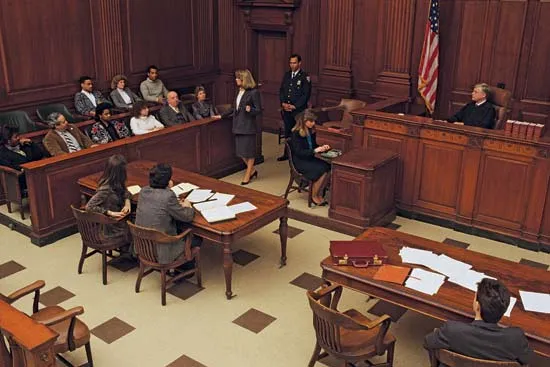
A judge issues and signs a search warrant.
1. Who can authorize a search warrant?
Although a search warrant is issued on behalf of the state (that is, by the prosecuting agency), the judge actually issues and signs it. 1 2 3 The purpose of having a judge issue the warrant…instead of the police or a prosecutor…is to ensure that a neutral, detached individual evaluates the circumstances of the criminal investigation.4
But before the judge can sign off, two requirements must be met: the judge must reasonably believe (1) that a misdemeanor or felony has been committed, and (2) that evidence of that criminal case is likely to be found in the place(s) described in the search warrant.5 If the facts presented in the warrant application are convincing, the judge must sign and issue the search warrant.6
Also, we should clarify the distinction between search warrants and two other common types of warrants. A Texas arrest warrant is usually issued when criminal charges have been filed, and it authorizes the police to arrest the person on the charges. A Texas bench warrant is issued by a judge for violating some rule of court, such as failing to appear for one’s court hearing or failing to pay a fine that was required as a condition of probation.
2. What are the search warrant requirements for police in Texas?
There are certain requirements that law enforcement must meet in order to obtain a search warrant in Texas. They must show probable cause that the locations to be searched contain evidence, instruments or fruits of criminal activity.
The following are examples of the types of grounds on which a Texas search warrant may be issued:
- if the sought property was allegedly stolen
- if the sought property was allegedly used as a means to commit a felony
- if the sought property is evidence of the fact that a felony has occurred or that a particular person has committed a felony
- if the sought property is in possession of someone who intends to use it to commit a crime or in the possession of another to whom he/she may have delivered it for the purpose of concealing it or keeping it from being discovered
- if the sought property reveals child pornography
- if an arrest warrant has already issued.7
It should be noted that if the sought property is held by an attorney, doctor, psychotherapist, or member of the clergy, a special procedure will be held before that evidence may be seized…and even then, the attorney, doctor, therapist, or clergyman must be the individual suspected of engaging in the alleged criminal activity.8
But before a judge issues a search warrant, he/she must have probable cause to do so.
Probable cause
“Probable cause” is a legal phrase. It refers to a “reasonable” belief that criminal activity is taking (or has taken) place. So before a judge issues a search warrant, he/she must have a reasonable belief that the person /property specifically described in the warrant application (otherwise known as an “affidavit”) will be found in the searched location.9
Before finding that probable cause exists, the judge may question (under oath)
- the officer,
- prosecutor, or
- state investigator10 who applied for the warrant, and
- any witnesses that the requesting individual relied on to determine that a warrant was necessary.
These affidavits may be written or oral, and presented in person, via the telephone, by fax, or even e-mail.11 They also must contain the facts that establish the grounds for the application or the probable cause for believing that they exist. Affidavits are under penalty of perjury.12
3. Are there rules as to the use of informants?
Police routinely rely on information provided by informants. Informants are individuals who provide information about people, organizations, or activities to the police without the consent of those people or organizations.
That said, the judge must be informed of some of the facts that led the informant to his/her conclusion that there is alleged criminal activity.13 A mere opinion that a person or property is involved in a crime is therefore insufficient without evidence to support it.
Since it is the judge who must determine if there is probable cause to issue the warrant, he/she must believe that the informant’s information is reliable. This may be established by:
- the identity of the informer,
- past experiences with the informant in which he/she has proven to be reliable, and/or
- corroboration by the officer’s personal observations or other evidence.14
The informant’s identity
The judge may require disclosure of the informant’s name or may require him/her to give a statement under oath as to the information he/she provided to the police.15 However, just because the informant’s identity is disclosed to the judge doesn’t mean it will necessarily be disclosed to the defense.
A judge is allowed to seal any or all of the affidavit to protect the identity of a confidential informant if that testimony helped establish the probable cause that led the judge to issue the warrant.16
Although the judge will not reveal the informant’s identity simply because you wish to use it to attack the judge’s finding of probable cause…he/she may ask the prosecutor to disclose it if your motion to traverse and quash the search warrant has merit.17

A defense lawyer can challenge the validity of a search warrant in multiple ways.
4. How can a defense lawyer challenge the validity of a search warrant?
Although motions to quash and traverse would be more appropriately explained in the final section titled “Motion to Suppress Evidence”, they merit discussion here, as they directly relate to informants and the probable cause required to obtain Texas search warrants.
A motion to “quash and traverse” challenges the affidavit (and underlying probable cause) that the judge relied on upon issuing the Texas search warrant. A motion to traverse challenges the truth of the affidavit. A motion to quash challenges the sufficiency of the affidavit (that is, even assuming the facts are true, whether they rise to the level of probable cause).
Although these motions may be filed separately or together, the terms are often used interchangeably. We will discuss them as one for the sake of simplicity.
Texas criminal defense lawyers may assert motions to traverse and quash a search warrant in three types of hearings:
- in a Franks hearing (to assert that the author of the affidavit (otherwise known as the “affiant”) provided false information,
- in a Luttenberger hearing (to assert that the informant provided false information), or
- in a Hobbs hearing (which is based on a sealed affidavit).
Franks hearings
If you request a Franks hearing to quash and traverse a warrant because you believe the supporting affidavit contains false information, you must set forth the reasons why you believe that it is inaccurate.18 Texas criminal defense lawyers may do this by demonstrating that:
- the affidavit contained a false statement,
- the statement was made knowingly or with reckless disregard for the truth, and
- that the statement was necessary (that is, “material”) to establish probable cause.19
It should be noted that if the affiant intentionally leaves out material information, he/she will be deemed to have provided materially false information “by omission”.20
The court must hold an “in camera” hearing if the judge believes that you have effectively challenged the truth of the affidavit.21 An in-camera hearing is a private hearing held in the judge’s chambers.
During this hearing, the judge may question the affiant or informant to determine whether the affidavit is accurate, false, or misleading.22
If the criminal defense attorney succeeds in proving that the affidavit contained false material information…and the remaining information is insufficient to support a finding of probable cause…the judge must quash the Texas search warrant. Once the search warrant is quashed, any evidence that was seized under the warrant will be suppressed.23
*Suppressed evidence is discussed in the section titled “Motion to Suppress Evidence”.
Luttenberger hearings
When the affidavit supplying the probable cause contains information from an undisclosed informant, it is extremely difficult to establish that the affidavit is false…which is the standard to get a Franks hearing.
But if the informant isn’t a material witness with respect to your guilt or innocence (an eyewitness to the alleged crime, for example), the prosecution is under no duty to disclose his/her identity.24
A Luttenberger hearing takes place when you want to attack the truth of the affidavit but don’t know the identity of the informant. In this hearing, the Texas criminal attorney may request information about:
- the informant’s reliability,
- his/her motive for providing information (for example, was the informant paid or offered leniency in exchange for his/her testimony?), and
- any statements that the informant made in connection with the case.
Although the burden of proof is less strict than a Franks hearing, the defense still must cast doubt as to the truthfulness of the informant’s testimony. If you accomplish this, the court will conduct an in camera hearing to determine if the statements are material.25
If the statements are material, the court will redact (or remove) any information that may disclose the informant’s identity before it provides you with the affidavit or supporting document(s).26
If, during this hearing, you discover that the informant is a material witness to your guilt or innocence, you would move to disclose his/her identity at a Hobbs hearing.
Hobbs hearings
At a Hobbes hearing, the defense asks the judge to reveal the identity of the confidential informant upon whose information the Texas search warrant got issued.
When the entire affidavit has been sealed to protect the informant’s identity, it may be too difficult even to qualify for a Luttenberger hearing. When this is the case, the court must conduct an in-camera hearing upon receipt of your motion to traverse or quash the Texas search warrant.27 Unless the prosecutor agrees, the hearing takes place without you or your criminal defense attorney.28
During this closed hearing, the judge must decide (1) whether to maintain the confidentiality of the informant, and (2) whether the affidavit has been properly sealed.29
If the court believes that the affidavit was properly sealed but doesn’t believe that the information contained in it was false or misleading, it will simply deny your motion.30
If, however, it believes that you may succeed in your motion, it will first give the prosecution the opportunity to disclose their informant or have the case dismissed if the judge rules in your favor.31 In our experience, the prosecution will generally dismiss the case before revealing or “burning” the police informant.
5. How are the police allowed to execute a warrant?
The contents of a Texas search warrant must be described with reasonable particularity.32 Simply put, “reasonable particularity” means that the warrant should be so clear that nothing is left to the officer’s discretion when executing it.33 This applies to both (1) the place to be searched, and (2) the person/property to be seized.34
This means that a search warrant must be executed according to the exact details contained in the warrant35 — warrants that are clear in their descriptions will be upheld and those that are unduly vague will not. The following are some examples taken from actual Texas court cases regarding law enforcement agency searches:36
Descriptions that were found not to be sufficiently clear —
- “all of the financial records”
- “other evidence”
- “stolen property”
- “certain personal property used as a means of committing larceny“
Items that were described with reasonable particularity —
- “personal property tending to identify the person in control”
- “bookmaking paraphernalia”
- “illegal deer meat and/or elk meat, etc.”
The more specific the language, the more likely the Texas search warrant will be upheld.
Time of execution
A Texas search warrant must be executed within ten (10) days of its issuance. If it hasn’t been executed within that timeframe, it becomes void.37
If the warrant expires, it may be reissued as long as the judge still believes there is probable cause to support it.38 It, therefore, follows that if the probable cause that existed at the time of the original issuance is no longer relevant, the judge will not reissue the warrant.
There are also restrictions on what time of day a warrant may be executed. As a general rule, a search warrant may only be executed between 7 a.m. and 10 p.m. If, however, the judge finds good cause, he/she may authorize service at any time of the day or night.39
“Good cause” means that there is a factual basis for believing that a nighttime intrusion would be justified based on exigent circumstances.40 If, for example, you have several outstanding warrants, service will be authorized whenever possible. When establishing good cause, the judge must consider both public safety and the safety of the officers serving the warrant.42
See our article on What happens after a search warrant is executed?
With respect to seized property…
The officer must provide a detailed receipt for any property that he/she seized during the search. The officer must leave the receipt with (1) the person from whom he/she took the property, (2) the person who possessed the property, or (3) where he/she found the property if it was taken without anyone being present.42
Once taken, the officer must keep the property in police custody until he/she presents it to the court.43
All that said, the police are not permitted to search and seize anyone or anything until they’ve announced their presence.
6. What is the knock and announce rule?
Before an officer may execute a Texas search warrant at a person’s home (or possibly his/her business44), the officer must
- knock on the door,
- announce him/herself as a law enforcement officer,
- inform the occupant that he/she has a search warrant, and
- give the occupant enough time to open the door.45
It should be noted that the third requirement may technically be completed after the occupant opens the door but in either event must be before the officer enters the home.46
There is no steadfast rule as to exactly how these knock-notice (also referred to as the “knock and announce rule“) requirements should be executed. So in order to determine whether the executing officers have legally fulfilled their duties under Texas’s knock-notice law, the court will look for substantial compliance.
“Substantial compliance,” in its simplest terms, means that the policies underlying the knock and announce requirements are achieved under the circumstances.47 These policies include:
- protecting a homeowner’s privacy,
- protecting innocent people on the premises,
- preventing situations that may otherwise encourage a violent confrontation between a homeowner and those who enter his/her home without notice, and
- protecting the police from a startled or fearful homeowner/occupant.48
The knock-notice rules…and the policies behind them…are to ensure that if and when the police force entry into your home, it is only because you knowingly refused their entry.
Forced entry
When is it okay for law enforcement officers to enter a home without permission? After their entry has been refused.
If you (as the owner or occupant) refuse to (1) open the door for the officers, or (2) permit them into your home, the police may break in through a door, window, or any other part of the house to execute the Texas search warrant.49 The same holds true if no one is home.50
Assuming someone is home, there must be some evidence of a refusal before the police may legally force their way in. This is most typically evidenced by either (1) an unreasonable delay in responding to the officers’ request to enter51 (which must be determined based on the facts of the specific case), or (2) an outright refusal where the homeowner or occupant tells the police that he will not open the door.52
Some examples of situations where Texas courts have held that unlawful forced entries took place include:
- where knock-notice requirements weren’t fulfilled (for example, although the officer announced his presence, he didn’t state his purpose)53
- where the officer simultaneously announced his presence and forced entry without giving the homeowner the opportunity to comply or refuse54
- where the forceful entry was only 20 seconds after the officers otherwise complied with the knock-notice rules.55
- where knock and announce rules weren’t followed when the officer entered the home to secure it while the warrant was being obtained56
- where the officer announced that he was a police officer (without stating his purpose) and only after he had already forced entry.57
There are, of course, certain times when officers are permitted to execute a Texas search warrant by forcing their entry even without complying with the knock-notice requirements.
Exceptions to Texas’s knock-notice rule
The following are some of the most common exceptions to the knock and announce requirement:
- consent (if someone in the home consents to the officer’s entry, the officer doesn’t need to proceed with knock-notice requirements)58
- public places (knock and announce rules are designed to respect a person’s privacy in his/her home — there is no similar privacy right in a public place)59
- exigent circumstances (“exigent circumstances” basically mean that “time is of the essence”).
When exigent circumstances are present, the knock-notice requirements may be waived. This is most typically the case where police suspect that those inside the home (1) may arm themselves, or (2) that drugs will be destroyed if they take must first knock and announce their presence.
It must be noted that there is no blanket exception for exigent circumstances, as each case must be independently evaluated.60 “[I]f the specific facts known to the officer before his entry are sufficient to support his good faith belief that compliance will increase his peril, frustrate the arrest, or permit the destruction of evidence,” the judge will likely excuse a knock-notice violation.61
Absent one of these recognized exceptions, a knock-notice violation may render any subsequent search and seizure unreasonable, and therefore, illegal.62 When a search and/or seizure is illegal, the prosecution will be prevented from using any of the seized evidence against you at trial.63
7. What is a motion to suppress evidence?
The most common challenge to a search warrant lies in a Texas Penal Code 1538.5 PC motion to suppress evidence. This motion may be filed if you wish to (1) recover seized evidence, or (2) exclude seized evidence from your trial. A Texas criminal defense attorney may file an “unreasonable search and seizure” Penal Code 1538.5 motion based on any of the following facts:
- that the Texas search warrant was insufficient on its face (this issue could also be raised in a motion to quash the warrant)
- that there was no probable cause to issue the search warrant (raised in either a motion to quash or traverse)
- that the seized property or other evidence was not specifically described in the search warrant (for example, the officers seized non-deadly weapons when the warrant specifically said deadly weapons)
- that the execution of the search warrant was illegal.64
If any part of the search was unlawful, any discovered evidence will typically be excluded under this section. As Darrell York, one of Ventura’s top criminal defense attorneys and a former Glendale police officer puts, “This ‘exclusionary rule’ is one of the most powerful defenses available.”
If your motion is granted, the prosecution will be prohibited from “using” the seized evidence against you at trial. A victory on this motion will often lead the prosecutor to dismiss (or at the very least significantly reduce) your charge(s).